
👨💻 The Key to Optimal Internships
As we make ourselves into the heart of summer, it’s clear that internship season is very much upon us. That means that college students and graduates are coming on board at diverse companies all over the country; at least for the next 10–12 weeks or so...


As we make ourselves into the heart of summer, it’s clear that internship season is very much upon us. That means that college students and graduates are coming on board at diverse companies all over the country; at least for the next 10–12 weeks or so.
With this in mind, it’s important to analyze the challenges that come along with an exciting opportunity to apply what you’ve learned in school.
Internships can be a tricky thing— both for managers and interns alike.
From the manager’s perspective, they have to find a project to assign their intern. This is often easier said than done when considering the brief time that the student will have to work on it, especially when you further take into account time spent with onboarding and getting settled.
The project also should be something impactful, something that will live beyond the several weeks of work that the intern puts into it. You don’t want to assign the infamous ‘intern project’ that never sees the light of day.
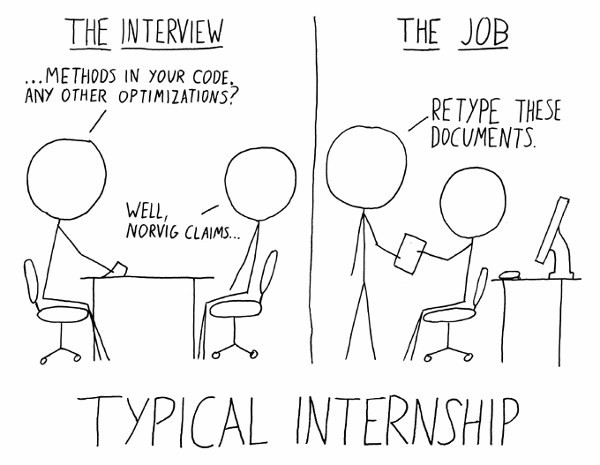
Lastly, the intern should find the work exciting, interesting, and educational. A summer of doing meaningless grunge-work isn’t going to leave the best impression on them, and you could risk missing out on a chance to convert a talented intern to full-time employee afterwards.
As an intern, there are some pain points to consider as well. The shortened time period definitely plays a factor. It can often lead to deadline-induced stress and sloppy work, especially if you are expected to pick up new technologies on the job — which is often the case. On the other end of the spectrum, if you aren’t somewhat interested by what you’re doing, then you’ll likely find yourself counting the seconds until end of day.
As one may expect, an intern’s experience is largely shaped by how cooperative and helpful those are around them. Their success is dependent on lots of variables that they don’t necessarily have full control over at all times. This is a tough pill to swallow and can often lead to over-working in order to compensate.
My Experience
It was July. I was about halfway through my first real, paid internship at the time. I was given a vague business problem to analyze and hopefully solve by the end of summer. But this was the last of my worries — I would definitely finish it. In fact, I could finish it by months end and move onto something else. Now, that would be really impressive.

Week after week, I was working nonstop and making consistent progress towards my end-goal for the project. On the other hand, what I wasn’t doing consistently, was meeting to discuss things with my manager — the key stakeholder for the project.
Eventually, I scheduled some time with him to go over the nearly-finished product. I came in with a super thorough, well-thought-out representation of my summer’s work. I left the room with nothing.
Due to a lack of communication, I had not answered the question that proved useful to the business. I had gone down a completely different path. This led to several pivots and long hours before I had anything resembling the initial vision of the project.
Shorten the Feedback Loop
It’s clear to me now that this isn’t the right way to do things. I can’t stress enough the importance of communication during an internship. It seems cliché, but it’s often overlooked.
Everyone loves to praise effective communication in the workplace, but few actually practice it.
Communication in internships can take many forms. Most often, it will take the form of a weekly one-on-one with you and your manager. Sometimes the key stakeholder for your project will be your manager, sometimes it won’t be. In the latter case, I would recommend meeting with your project stakeholder frequently as well, in order to ensure that you’re on the right track.
The most significant factor in a successful internship is communication. Plain and simple. Shorten the feedback loop and you’ll optimize your experience.
This will take time out of your project work. It may be hard for you to do this (I know I struggled). I’m well aware that engineers are hard-wired to dislike meetings. However, the time it will save you in the long-run will be worth it. These meetings can be 15–30 minute blocks or they can be more casual in the form of a quick update by the coffee maker. Regardless, they need to happen. Rip the bandaid off and embrace it.
Let’s Recap
If you are going into your internship with one thing on your mind, it should be to shorten the feedback loop between you, your manager, and your key stakeholders for your project.
This will allow you to iterate quickly, make mistakes, correct them, and ship beautiful work by summer’s end. An extra hour or so of meetings a week can save you dozens of hours dealing with unnecessary backtracking, pivoting, and manic hacking.
The pivot is overrated — instead, let’s work smarter.
Remember to communicate, shorten the feedback loop, and optimize your internship for everything it’s worth. Most importantly, don’t forget to be grateful for the opportunity you have, and make the most of it. Good luck.
Thanks for reading! If you enjoyed this post and you’re feeling generous, perhaps follow me on Twitter. You can also subscribe in the form below to get future posts like this one straight to your inbox. 🔥


